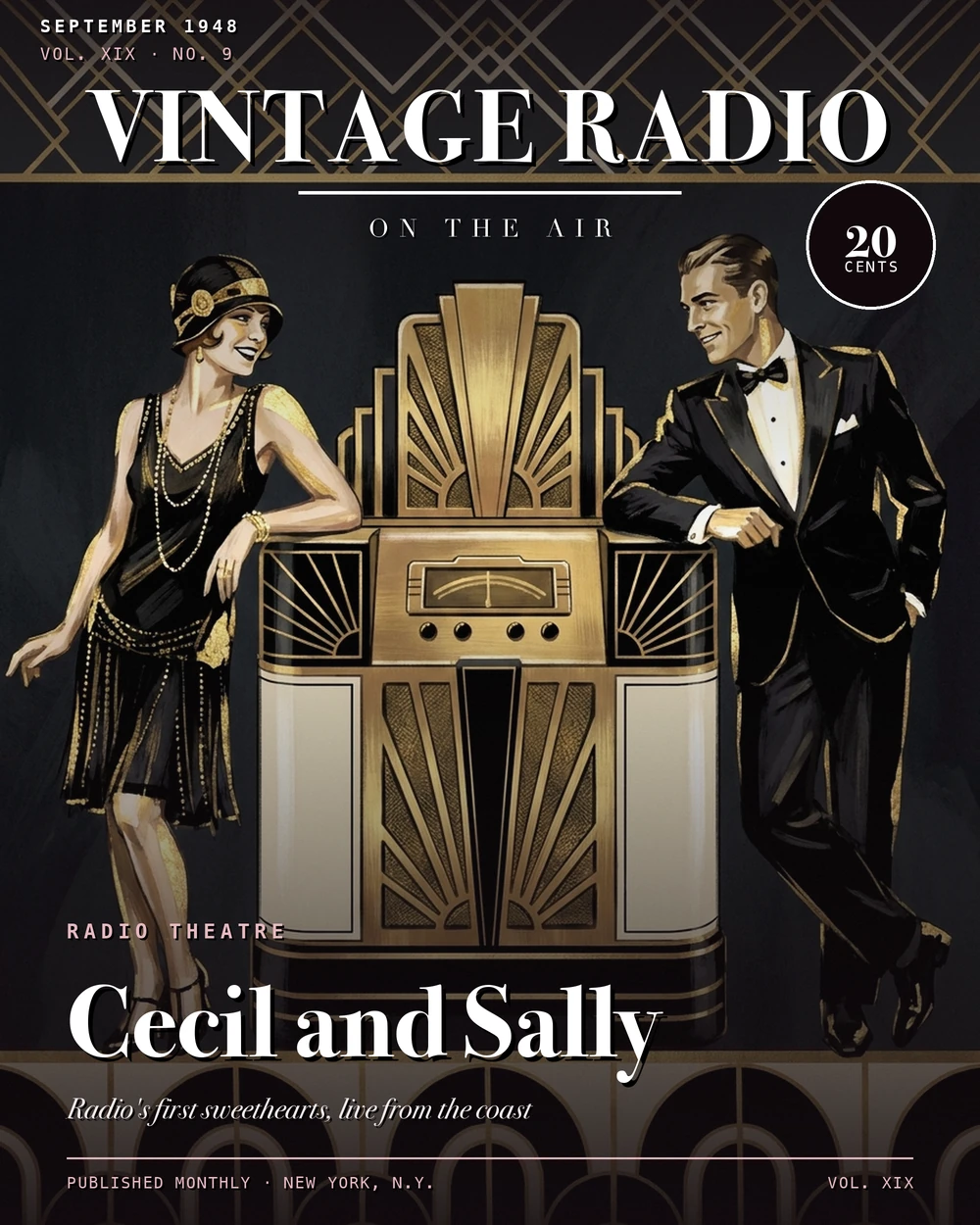
Cecil and Sally
How It Started
Cecil and Sally didn't come from a writers' room or a network development deal. It grew out of improvised office banter at San Francisco's KYA radio station in 1928, where announcer Johnny Patrick — born John Patrick Goggan — and staff organist Helen Troy started riffing on each other between broadcasts. The two characters they developed were small-town teenagers in an ongoing courtship: Cecil, raised by his Aunt Bessie, and Sally, raised by her Uncle Thomas, with a rival named Alexander periodically complicating things by competing for Sally's affections.
The show first aired under the title The Funniest Things on the West Coast connection of the short-lived ABC network, then moved to KPO and the NBC Pacific Coast Network after ABC went bankrupt in 1929. What distinguished it from the start was how it sounded. Troy played Sally with a girlish lisp that turned "Cecil" into "Theethil," and Patrick wrote and sang while Troy sang and played piano and organ. It wasn't sketch comedy in the Abbott and Costello mold — it was closer in spirit to Burns and Allen or Easy Aces: a boy-girl two-act built around the rhythms of courtship and the small frictions of everyday life.
The Reach It Built
Starting in 1930, Cecil and Sally was distributed nationally through electrical transcriptions — large, long-playing phonograph discs recorded at the MacGregor and Sollie studio in San Francisco and mailed out to stations across the country. This was the same method that had made Amos 'n' Andy a national phenomenon, and it worked just as well here. By 1930 the show was heard on 53 radio stations in the United States, and transcriptions were reaching as far as Australia and New Zealand. The estimated audience had grown to over 15 million fans.
Each episode ran approximately 10 to 15 minutes, leaving room for local stations to insert their own introductions, outros, and commercials. The episode titles give a sense of the show's domestic, low-stakes comedy: "Sally Can't Find Her Purse," "Cecil Tries to Lose the Sweater," "Sally Ties Cecil's Tie," "Deciding to Go to a Movie." One multi-episode arc followed a pink sweater Sally gives Cecil — Cecil tries to get rid of it, then has to convince Sally he wanted it all along. Patrick wrote more than a thousand scripts in total over the run.
How It Ended and What Came After
The show ran until 1933, making it one of the earliest radio programs to achieve national distribution via electrical transcription. In 1933–1934, Patrick and Troy took a live stage version on tour to theatres in the west and midwest, but the partnership broke apart after Patrick filed for bankruptcy following the tour.
Both went on to significant careers. Helen Troy — born in 1903 — moved to programs including Carefree Carnival in 1934 and Texaco Town hosted by Eddie Cantor in 1937, and had a brief film career appearing alongside Mickey Rooney, Judy Garland, and Spencer Tracy. She died in 1942 at 38. Johnny Patrick became a successful playwright and Hollywood screenwriter: he adapted The Teahouse of the August Moon for the stage in 1953, winning both a Pulitzer Prize and a Tony Award, and later wrote screenplays for Three Coins in the Fountain (1954), Love Is a Many-Splendored Thing (1955), and High Society (1956). Both Patrick and Troy were inducted into the Bay Area Radio Hall of Fame in 2006 as part of its inaugural class.
What Survives
The catalog here contains 8 episodes — a small fraction of what Patrick produced. Radio historian Doug Hopkinson has documented the series extensively in old-time radio club journals and pursued preservation of surviving recordings. As of 2021, an estimated 633 episodes were believed to exist in a private collector's hands, far more than the roughly 270 previously known. Cecil and Sally ran from 1928 to 1933, placing it firmly in the late 1920s and early 1930s — an era of radio comedy that predates the better-remembered names of the medium's later golden years, which is part of why the show occupies a quieter corner of the history. What's here is a window into how the form was still being invented.